How to do customer discovery interviews: a playbook
Five steps to run customer discovery interviews for a B2B SaaS, from who to ask to when to stop.
November 8, 2026, 7 min read

To do customer discovery interviews well, pick one narrow group of buyers, ask each person about the last time the problem cost them something, talk less than they do, and keep a tally of what repeats. Plan for about a dozen calls in that one group, and stop when you can predict the next answer.
Most guides on customer discovery give you a list of questions. The questions matter less than the order of the work around them. This playbook walks through five steps for a founder of a small B2B SaaS who wants first customers, not a research report. If you have not yet tested the idea at all, start with how to validate a SaaS idea before you build it and come back here for the interviews.
Step 1: Narrow the segment before you book a single call
The number of interviews you need depends on how alike your people are. A 2022 systematic review of 23 saturation studies in Social Science and Medicine found that studies reached saturation within 9 to 17 interviews, particularly with relatively homogenous groups and narrowly defined objectives. The few outliers with mixed groups needed larger samples.
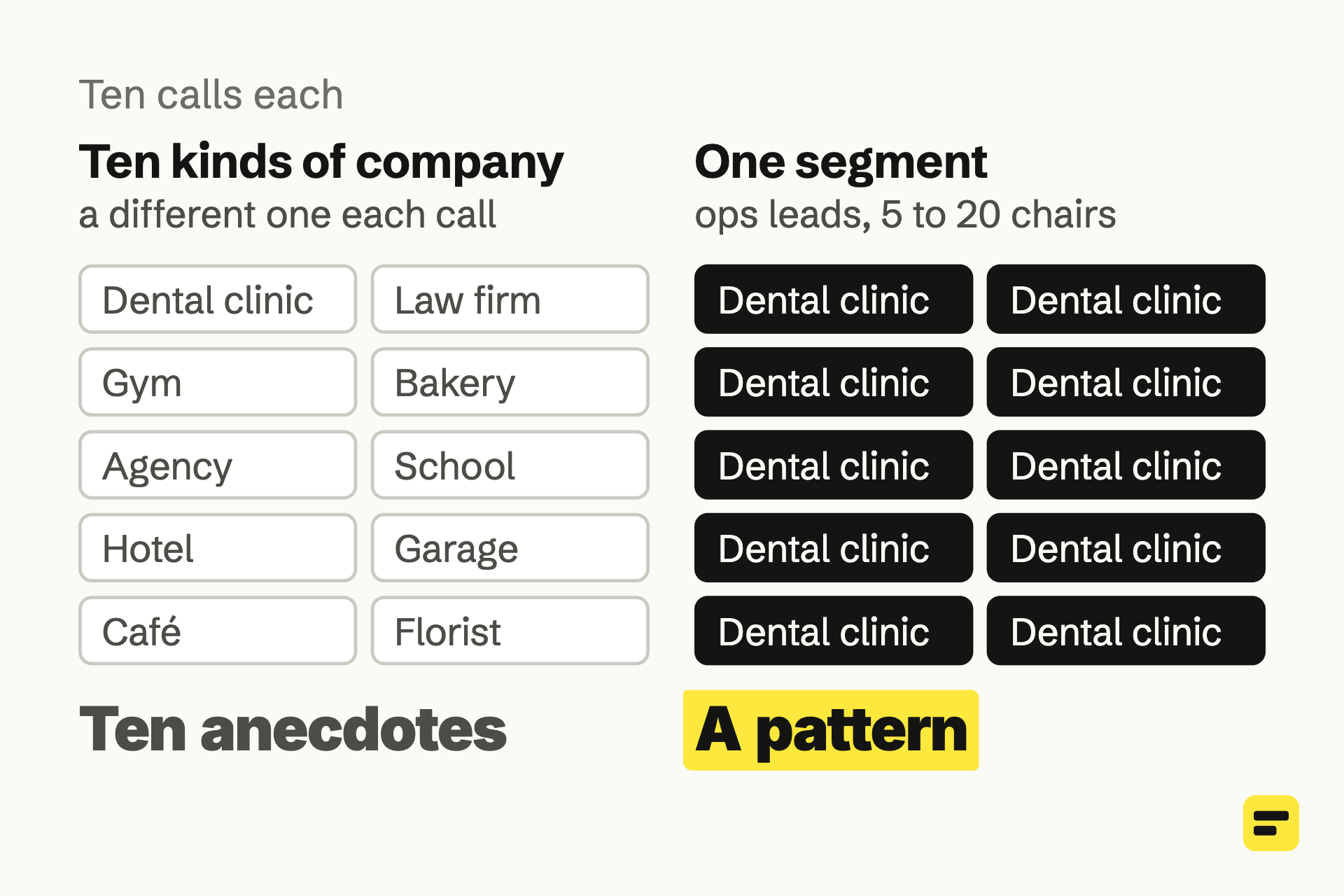
For a founder this is a planning rule, not an academic detail. Ten calls with ten different kinds of companies give you ten anecdotes. Ten calls with operations leads at dental clinics of 5 to 20 chairs give you a pattern. Write your segment down in one line before you recruit anyone.
- One role: the person who feels the problem each week
- One company type and size band
- One trigger: the event that makes the problem urgent, such as a new hire or a failed audit
- One exclusion: who looks similar but is not your buyer
If the line is hard to write, the ideal customer profile for B2B SaaS post shows how to go narrower without guessing.
Step 2: Recruit people who already have the problem
Friends and former colleagues say yes to a call, but they are polite and rarely in your segment. Better sources are people who have described the problem in their own words, in public, recently. Look for threads where someone asks how others handle the task you want to fix, or complains about the tool they use for it. A short reply that answers their question, then a message asking for 20 minutes to hear more, gets a different kind of call than a cold pitch.
LitePal does the first part of this search for you: paste your site and it finds public threads on Reddit, Hacker News, X and Threads where people ask for a product like yours, with a reply drafted for each. It also finds companies that fit and the right person to write to, with a checked email. You still post and send from your own accounts. If you recruit by email, finding the decision maker at a company explains who to write to for a buyer call versus a user call.
In the invitation, say plainly that you are not selling. Ask about their work, not your idea, and give a fixed length such as 20 minutes. Offer a summary of what you learn from all the calls as a thank-you.
Step 3: Ask about the past, not about your product
In his Y Combinator Startup School lecture, Eric Migicovsky named three common errors in user interviews and five questions to ask instead. The errors: talking about your idea, asking about hypotheticals such as whether they would use a feature you might build, and talking too much. The five questions follow the opposite rule:
- What is the hardest part about doing the thing you are trying to solve
- Tell me about the last time you encountered this problem
- Why was this hard
- What, if anything, have you done to try to solve this problem
- What do you not love about the solutions you have already tried
The second question carries the most weight. A story about last Tuesday has names, tools, hours and money in it. An opinion about the future has none. When someone drifts into what they would want, bring them back with "when did that last happen". Keep your product closed until the last five minutes, and show it only if they ask.
Step 4: Run the calls in small batches and code as you go
Do not book 30 calls and read your notes at the end. Nielsen Norman Group advises to start with a small sample of 5 or 6 and analyze as you go, adding people only while new themes still appear. The same article reports the Guest, Bunce and Johnson study: of 36 high-frequency codes, 34 had appeared after 6 transcripts and 35 after 12.
After each call, spend ten minutes on three lines: the trigger that started the problem, what they do about it today, and what that costs them in time or money. Put each line into a shared sheet. By the sixth call, you will see which lines repeat.
Here is a worked example for a hypothetical scheduling tool for dentists. The plan is one segment, so the review above points to 9 to 17 calls. Book a first batch of 6, the NN/g starting point. Suppose 6 of the first 6 calls name missed recalls as the trigger, and 4 of 6 track recalls in a spreadsheet. Book a second batch of 6. If calls 7 to 12 add no new trigger and no new workaround, you stop at 12, the point where Guest and colleagues saw 35 of 36 codes. Now suppose you also want to sell to orthodontists. That is a second segment, so the same plan doubles: 2 segments times 12 calls is 24 calls, not 12 calls split in half.

Step 5: Turn the notes into one decision, then keep talking
Discovery ends in a decision, not a document. Read your sheet and answer three questions:
- Does a clear majority of the segment share the same trigger
- Do they already spend time or money on a workaround
- Did anyone ask to see what you are building, or to be told when it is ready

Three yes answers mean you build for this segment and go back to the people who asked to see it: they are your first design partners. Two or fewer mean you change the segment or the problem, not the questions, and run another batch.
Then keep a habit. Teresa Torres of Product Talk writes that good product discovery teams engage with customers at least weekly, so they make fewer decisions without customer input. For a solo founder, one call a week is enough to catch a shift in the market before your churn does. Add a slot to your calendar now, and fill it from the same public threads you used to recruit.
Customer discovery interviews checklist
- Segment written in one line with role, company type, trigger and exclusion
- Invitation says you are not selling and names a fixed length
- Five questions on one card, the last-time question first in your mind
- Product closed until the last five minutes
- Three lines of notes in a shared sheet after each call
- First batch of 5 or 6, then more only while new themes appear
- A decision after the batch, and one call a week after that
Paste your site into LitePal to see the public threads where people already describe the problem you solve, each with a reply drafted, and invite those people to your next round of calls.

