Best time to send cold emails matters less than you think
What the send-time data really shows, how small the gap is, and where a founder's hour does more good.
November 11, 2026, 6 min read

The best time to send cold emails is a weekday morning, Tuesday to Thursday, in the reader's own time zone. That is the whole answer. The data behind it is real, but the gap between a good hour and a bad hour is small. Set your send window once, then put your time into who you write to and what you say.
Most guides on this topic treat the send time as a secret lever. This post takes the opposite view. It reads the two largest public data sets closely, shows the arithmetic, and compares the gain from timing with the gains and losses that sit elsewhere in a campaign.
What the send-time data says
Belkins, an outbound agency, published a study of more than 7.5 million cold emails sent through its campaigns in 2025. The page was updated in June 2026. Its findings by day are close together: Wednesday and Thursday both reached a 0.48% reply rate, Monday and Tuesday 0.45%, and Friday 0.44%. Saturday dropped to 0.35%.
By hour, the same study found that morning sends between 8 AM and 12 PM had the highest reply rate at 0.54%, with early morning (5 to 8 AM) at 0.52%. The afternoon window, 12 to 5 PM, carried the largest share of all sends but replied at 0.47%. Belkins also reports a meeting rate of 0.4% for morning sends against 0.1% for the afternoon.
Instantly, a cold email tool, reports a slightly different pattern. Its 2026 Cold Email Benchmark Report found that Tuesday and Wednesday saw peak reply rates, with Wednesday the best day. The same page advises founders to schedule around the recipient's local working day, not the sender's.
So the two sources agree on the broad shape: midweek beats Friday and the weekend, and mornings beat afternoons. They do not agree on the exact best day. When two large data sets disagree on the winner, the winner is not worth chasing.
How small the gap is: a worked example
Take a founder who sends 1,000 cold emails in a month. Use the Belkins rates above and do the sums openly.
- All 1,000 sent in the morning window: 1,000 x 0.54% = 5.4 replies.
- All 1,000 sent in the afternoon window: 1,000 x 0.47% = 4.7 replies.
- Difference from the hour of day: 0.7 replies for every 1,000 emails.
- All 1,000 sent on a Wednesday: 1,000 x 0.48% = 4.8 replies.
- All 1,000 sent on a Friday: 1,000 x 0.44% = 4.4 replies.
- Difference from the day of the week: 0.4 replies for every 1,000 emails.

Less than one extra reply per thousand emails. For a founder who sends 30 or 40 emails a day, that is roughly one extra reply a month from perfect timing. It is worth having, because it costs nothing once the schedule is set. It is not worth an afternoon of A/B tests, and it cannot rescue a campaign that gets no replies at all.
Note also what these averages hide. They pool many industries and many offers. A reply rate near 0.5% is low compared with what a small, well-aimed list can reach, and the post on what counts as a good cold email reply rate explains why the average is a weak target. The spread between a good list and a bad list is far wider than the spread between Wednesday and Friday.
Where the bigger losses hide
Timing moves results by fractions of a percent. Deliverability can move them to zero. Google's sender guidelines tell everyone who sends to Gmail to keep spam rates reported in Postmaster Tools below 0.3%, and to set up SPF or DKIM authentication. Yahoo's sender best practices set the same line: keep your spam rate below 0.3%, with SPF or DKIM at a minimum.
Put that next to the worked example. In 1,000 delivered emails, 0.3% is three spam reports. Three annoyed readers can do more harm to a domain than the morning window can ever add back in replies, because mail that lands in spam gets no replies at any hour. The guide on how to keep cold emails out of spam covers the setup step by step.
The other large loss is the wrong reader. An email to a person who does not own the problem gets ignored on Wednesday morning just as fast as on Friday night. A clear path to the decision maker at a company does more for the reply rate than any send window.
How to set your send time once and move on
Here is a short routine that takes the timing question off your list for good.
- Group your list by the reader's time zone, not yours.
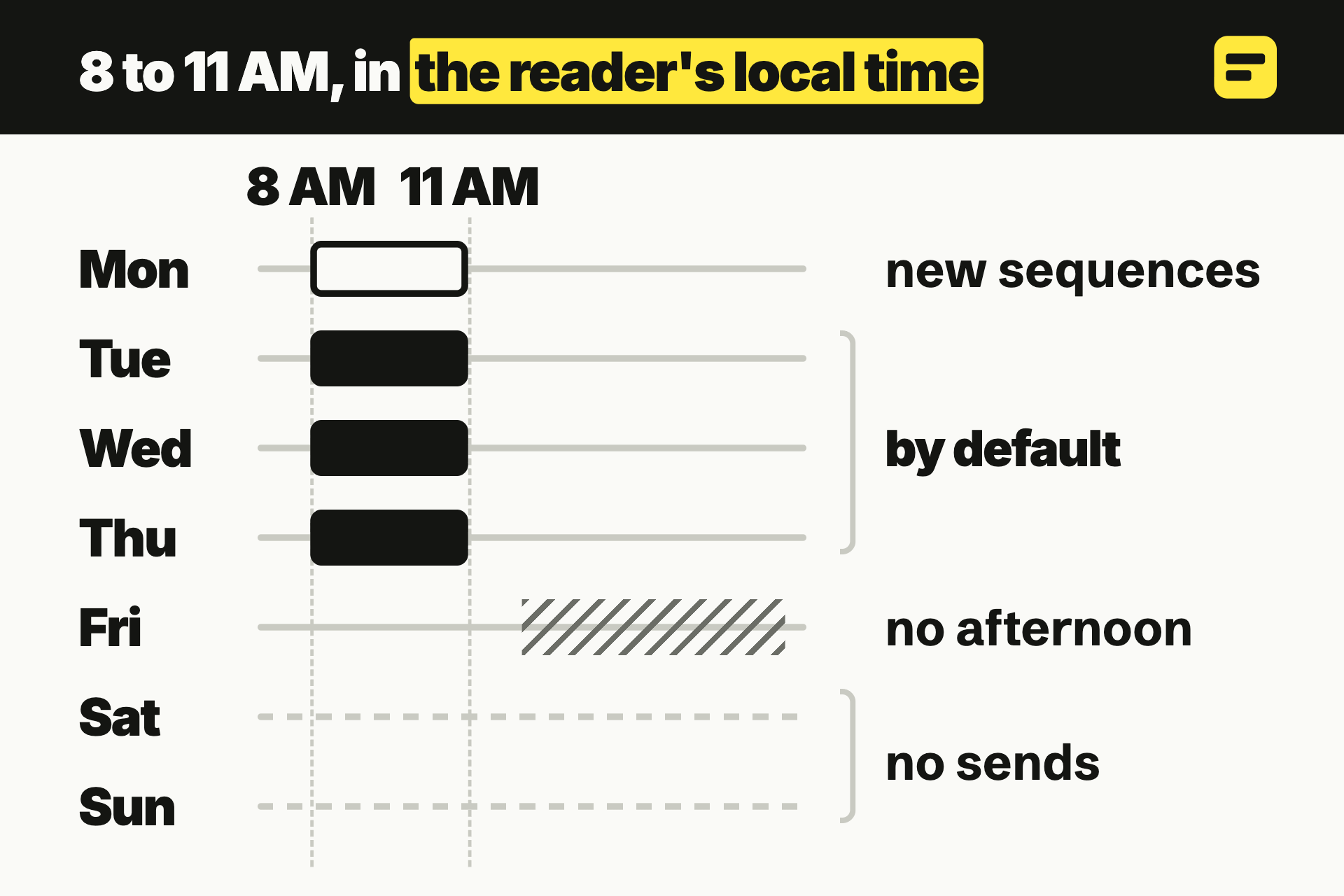
- Schedule sends for 8 to 11 AM in each reader's local time.
- Send Tuesday to Thursday by default, and keep Monday for starting new sequences.
- Avoid Friday afternoon, Saturday and Sunday.
- Spread sends through the window instead of sending a whole batch at one minute.
- Review the window once a quarter, not once a week.
Do not test send times before you have a list and a message that already get some replies. With a small list, the noise from one or two replies will be larger than the real effect of the hour. A test of 200 emails per arm at a 0.5% rate expects one reply on each side, which tells you nothing.
What to do with the hours you save
The hours that go into timing tests are better spent on three things. First, a list of companies that truly fit, so each reader has the problem you solve. Second, the right person at each company, with an email address that is checked before you send, so bounces stay low. Third, a first line that shows you know why you are writing to this person now.
This is the part of outreach that LitePal helps with. From a founder's site it finds companies that fit, the decision-maker to write to with a checked email, and a drafted first line. The founder still sends from their own account, at the time they choose, so the schedule above stays fully in their hands.
A good send time is a setting, not a strategy. Pick a weekday morning in the reader's time zone, protect your domain, and write to people who have the problem. Those three choices decide almost all of the result.
Paste your site into LitePal to get a list of companies that fit, the right person at each with a checked email, and a first line drafted for every one of them.

