Cold email call to action: 6 ways to earn a reply
Six rules for the last line of a cold email, with the data and platform rules behind each one.
November 17, 2026, 7 min read

The best cold email call to action is one short question about interest that a stranger can answer in one word. Ask whether the problem is worth a conversation, not for thirty minutes on a calendar. The meeting request comes later, after they reply. Here are six ways to write that last line, each with the data or the rule behind it.
The last line gets less attention than the subject line, but it is the only line that tells the reader what to do. If you are still working on the rest of the message, start with how long a cold email should be and come back for the ending.
1. Ask about interest, not for a meeting
Gong Labs sorted the endings of sales emails into three kinds. A specific ask names a day and time. An open-ended ask wants a meeting some time next week. An interest ask wants no meeting at all, only an answer to a question such as whether the reader would like to learn more. In Gong's analysis of 304,174 sales emails, published in 2020, the interest ask was the highest performing call to action for cold emails. Success meant a meeting booked within the next 10 days, so a reply asking to be removed did not count.
The reason is simple. A stranger has no cause to give you time yet. A question about interest sells the conversation, and the conversation sells the meeting. A meeting request in the first email asks for the largest thing you could want before you have earned the smallest.
2. Make one ask that takes one word to answer
Hunter's State of Email Outreach 2026 report asked decision makers what they want from a first email. They prefer low-pressure asks such as "Can I send more info?" and "Open to learning more?" over scheduling a meeting upfront. Both questions have something in common: the reader can answer yes or no from a phone, without opening a calendar or reading a page.
Two asks in one email cancel each other. If you offer a call, a demo video and a reply, the reader has to choose, and the easy choice is to do nothing. Pick the one answer you want and end on it.
- Weak: Let me know your thoughts, or grab a time on my calendar, or check out the demo
- Better: Is missed appointments a problem you are working on this quarter
- Better: Worth sending you a two-minute overview
- Better: Are you the right person for this, or is it someone else on your team
3. Keep the pitch out of the ask
The same Hunter survey found that 65% of decision makers say cold emails fail because they feel too sales-focused, the most common complaint in the report. An ending that restates features and promised returns is where that feeling comes from. Gong's data points the same way: across more than 132,000 emails, return-on-investment language in cold emails lowered success rates by 15%.
So the last line should not carry a claim. Make it a question about their situation, not a sentence about your product. If the email needs a number, put it in the body and attach it to a source or a customer, not to the ask.
4. Use few links, and make them plain
A link is a second call to action, even when you do not mean it as one. A first email that ends on a question does not need a calendar link. Send the link once they say yes. If you include one, follow Google's sender guidelines, which say web links in the message body should be visible and easy to understand. In practice, show the full address of your own site so the reader sees where it leads.
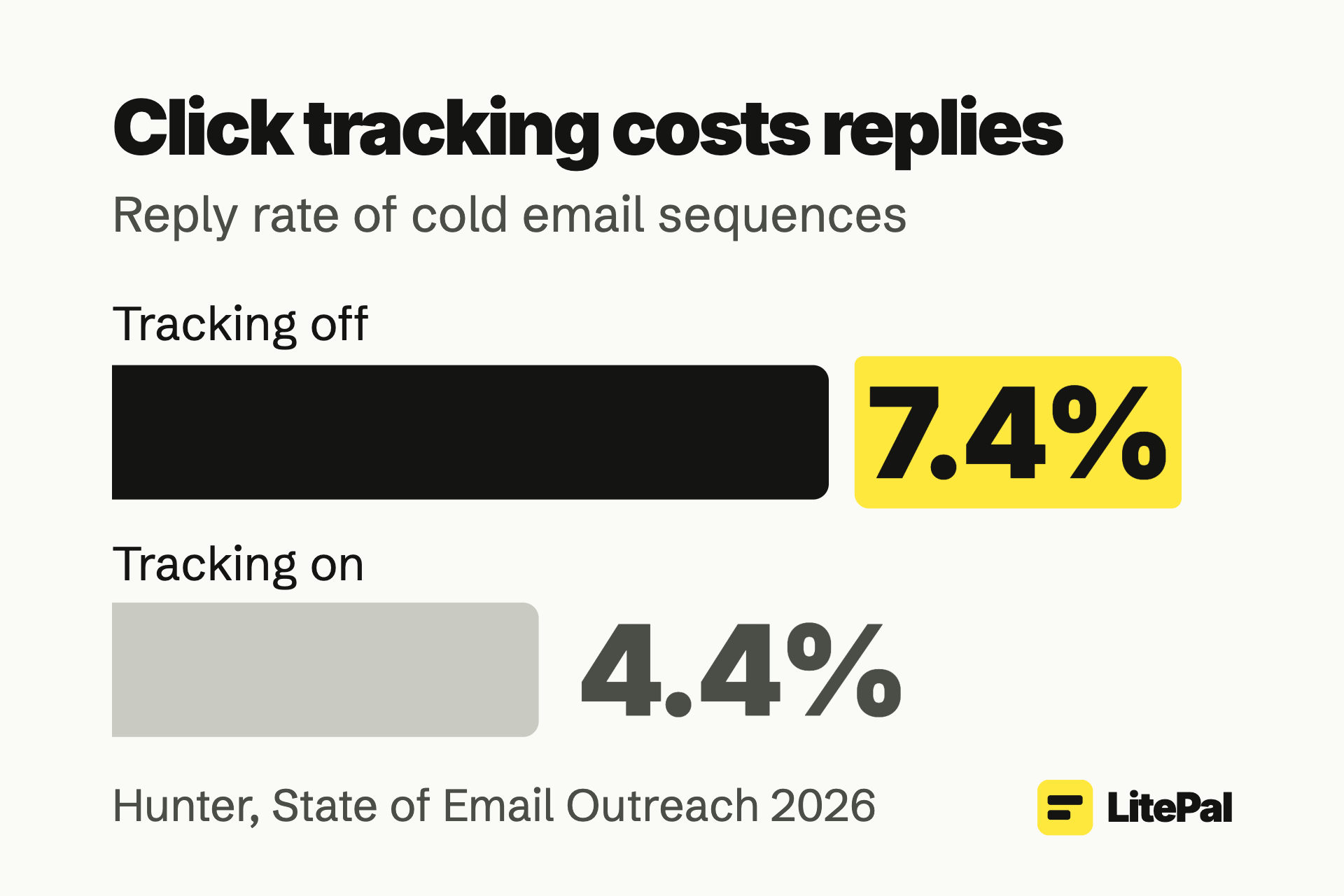
Click tracking also has a cost. In Hunter's data, sequences with tracking turned off had a 7.4% reply rate against 4.4% with tracking on. The report's advice is to avoid tracking link clicks unless you really need to.
5. Keep the opt-out separate from the ask
Under the US CAN-SPAM Act, a commercial email must include a clear and conspicuous explanation of how the recipient can opt out, and the sender must honor an opt-out request within 10 business days. The FTC's compliance guide puts the penalty at up to $53,088 for each email in violation. The guide on whether cold email is legal covers the rules in other regions.
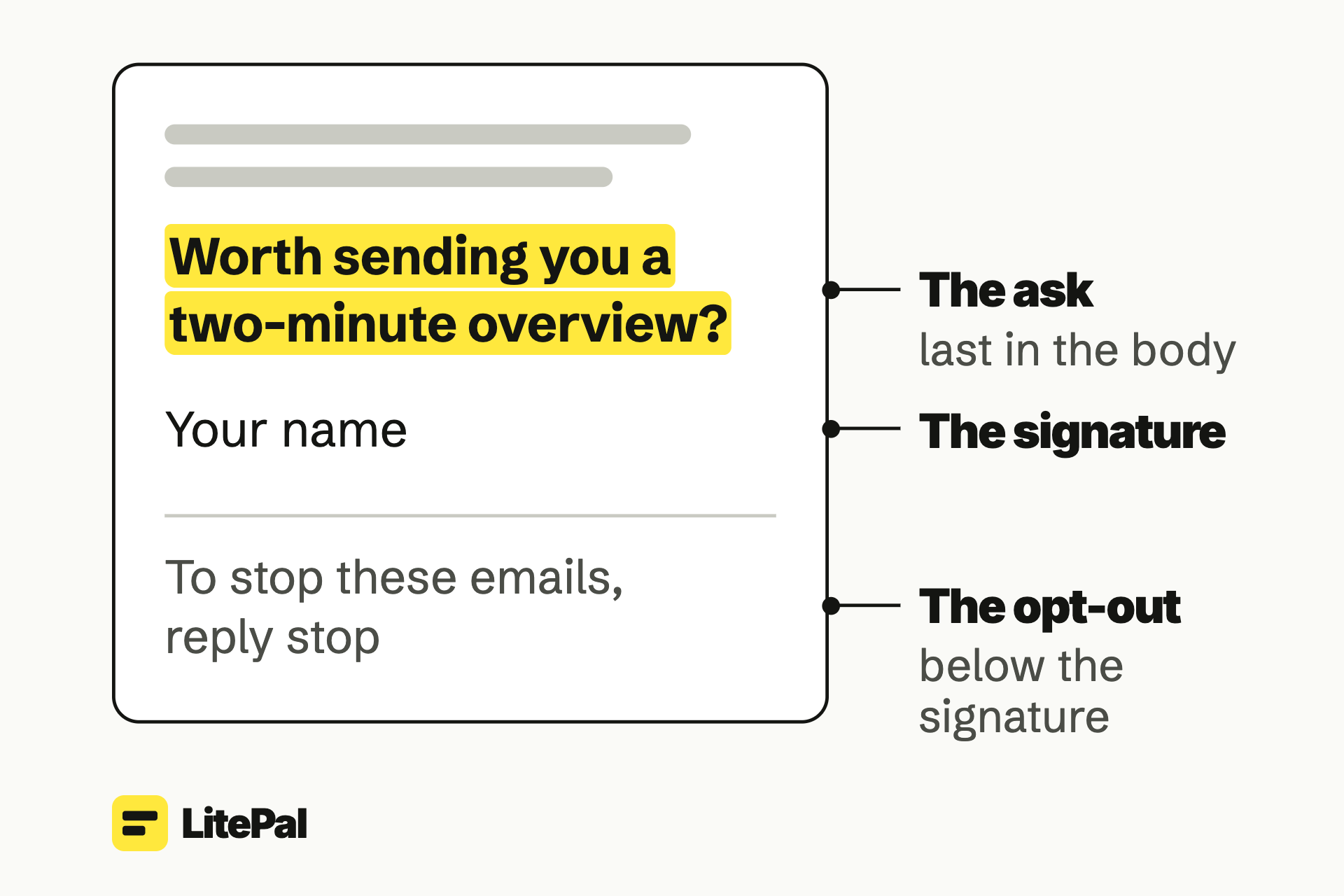
The opt-out line is not your call to action, and it should not compete with it. Put the question last in the body, then your name, then one plain sentence below the signature that says how to stop further emails. A reader who wants out can find it, and a reader who is curious still sees the question as the last thing you asked.
6. Change the ask once they reply
The interest question is for strangers only. Gong advises dropping it the moment a deal is open. In the same study, the specific ask booked a meeting 15% of the time in cold emails and 37% of the time once a deal was open. After a reply, vague asks slow things down. Name a day and a time, and offer one alternative.

In practice the sequence is short. The first email asks about interest. The reply to a yes proposes Tuesday at 4pm or Thursday at 10am. A reader who has shown interest wants the next step to be easy, and a specific time is easier than an open question about availability.
What a good cold email call to action is worth
Take a hypothetical product: a scheduling tool for dentists. The founder writes to 50 practice owners. Hunter reports that sequences of 21 to 50 recipients averaged a 6.2% reply rate, against 2.4% for sequences of more than 500. The arithmetic for the small list is 50 x 0.062 = 3.1, so about 3 replies. At the large-list rate, the same 50 people would give 50 x 0.024 = 1.2, about 1 reply.
Three replies is not many, which is why the ending matters. Each reply is a person who read to the last line and decided to answer it. If that line asked for 30 minutes, some of the three stay silent. If it asked a question they could answer with yes, the founder has three conversations, and then uses the specific ask from rule 6. By Gong's numbers that ask works 37 / 15 = about 2.5 times as often after a reply as it does cold.
A caution on the data: Gong's study measured its own customers' sales teams in 2020, and Hunter's report covers emails sent by Hunter users in 2025. Treat the numbers as direction, not as a promise for your list. For what to expect in total, see what counts as a good cold email reply rate.
A short checklist before you send
- The email ends on one question, and the question is about interest
- The reader can answer in one word, from a phone
- The last line holds no claim about results or returns
- The first email has no calendar link and no tracked or shortened link
- A plain opt-out sentence sits below the signature
- You have a day and a time ready for the moment they say yes
The ask also depends on who receives it. A question about missed appointments only works when it reaches the person who owns that problem. LitePal finds companies that fit your product, the decision-maker to write to with a checked email, and drafts a first line for each. You send every email from your own account.
Paste your site into LitePal to get a list of companies that fit, the right person at each, and a drafted first line, so the question at the end of your email reaches someone who can answer it.

