How long should a cold email be? Less than you fear
What the cold email length studies really measured, why their numbers disagree, and what to fix before you count words.
November 6, 2026, 6 min read
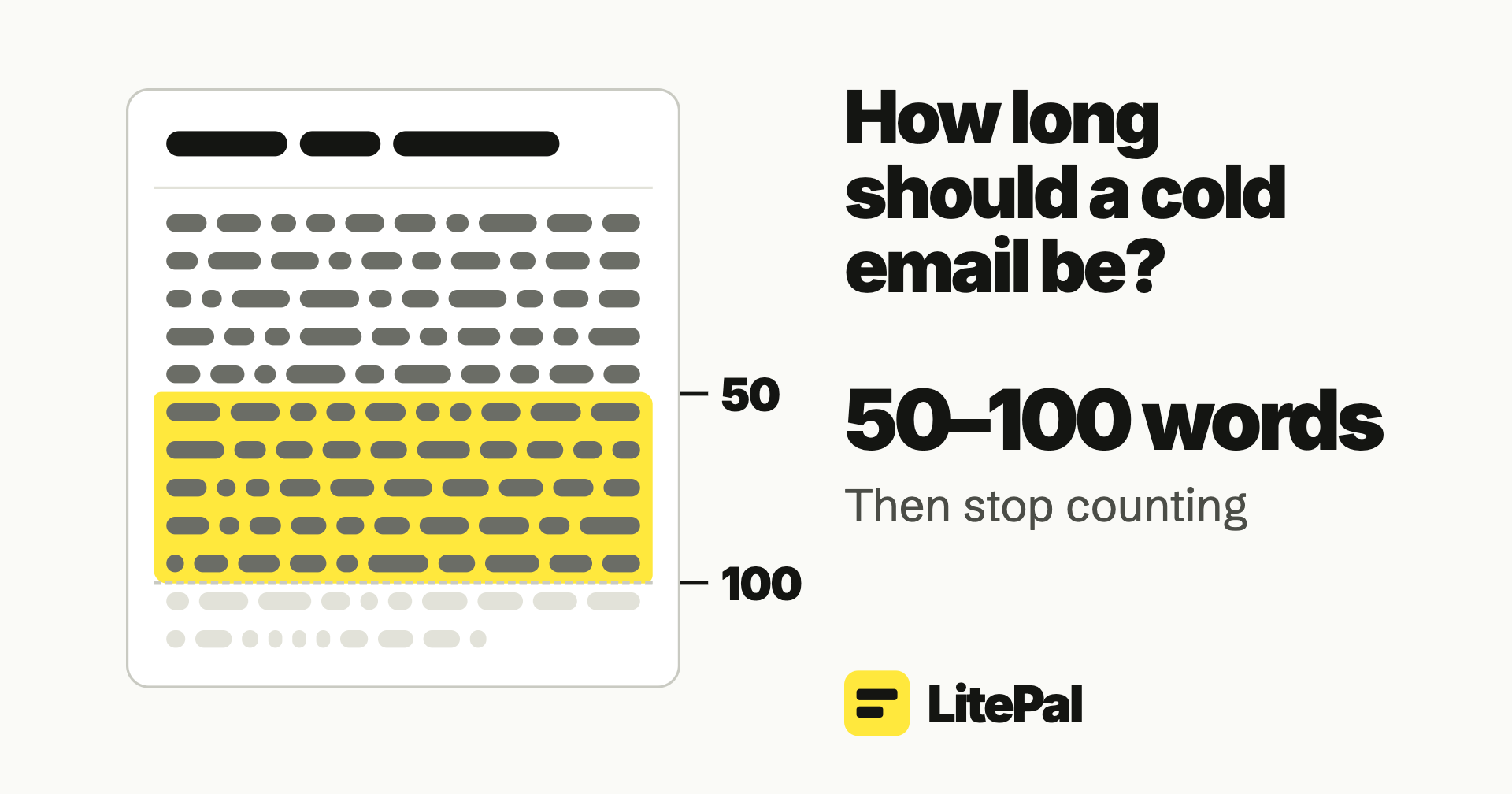
How long should a cold email be? Aim for 50 to 100 words: long enough to say why you write to this person, short enough to read on a phone in one screen. Then stop counting. The best public data on cold email shows that length moves reply rates far less than most advice claims.
That is the contrarian part of this post. Founders spend an hour cutting a draft from 140 words to 90, and then send it to the wrong person with a vague ask. The word count is the easiest thing to measure, so it gets the most attention. It is not the thing that decides whether someone replies.
Where the 50 to 125 words rule comes from
Most posts on cold email length repeat one number: 50 to 125 words. It comes from a 2016 Boomerang study. Boomerang looked at over 40 million emails that its users asked to be reminded about, and found that emails between 50 and 125 words had response rates above 50%.
Read that number again. A response rate above 50% is not a cold email number. Boomerang is an email productivity tool, and its users mostly wrote to people who already knew them: colleagues, clients, vendors. Hunter made the same point in its own study, noting that the Boomerang dataset must have held a large share of warm email and that a 51% reply rate is not realistic for outreach at scale. The rule is ten years old and was measured on a different kind of email.
The cold email studies disagree with each other
When you look only at studies of cold email, the answers spread out. Lavender, a cold email coaching tool, says the optimal cold email length is between 25 and 50 words (January 2023). Hunter analysed 34 million cold emails sent through its sequences between 2022 and 2024 and found that emails of 20 to 39 words had the highest average reply rate.

Gong points the other way. Its data shows that longer emails, which it defines as 30 to 150 words, are more effective at booking a meeting, as long as they connect the prospect to the offer. Gong measures meetings booked, not replies, which is one reason the answers differ. A short email can get a quick no. A longer one can get fewer replies but more calls.
So one study says 25 to 50 words, one says 20 to 39, and one says up to 150. If length were the lever everyone claims, the studies would agree more than this.
How much length really moves the reply rate
Hunter published the whole table, which is rare and useful. The best band, 20 to 39 words, had a 4.5% average reply rate. Emails of 200 words or more had 3.7%. The worst band, 40 to 59 words, had 3.4%. In Hunter's own words, the difference between lengths is not spectacular, and much longer emails get similar results.
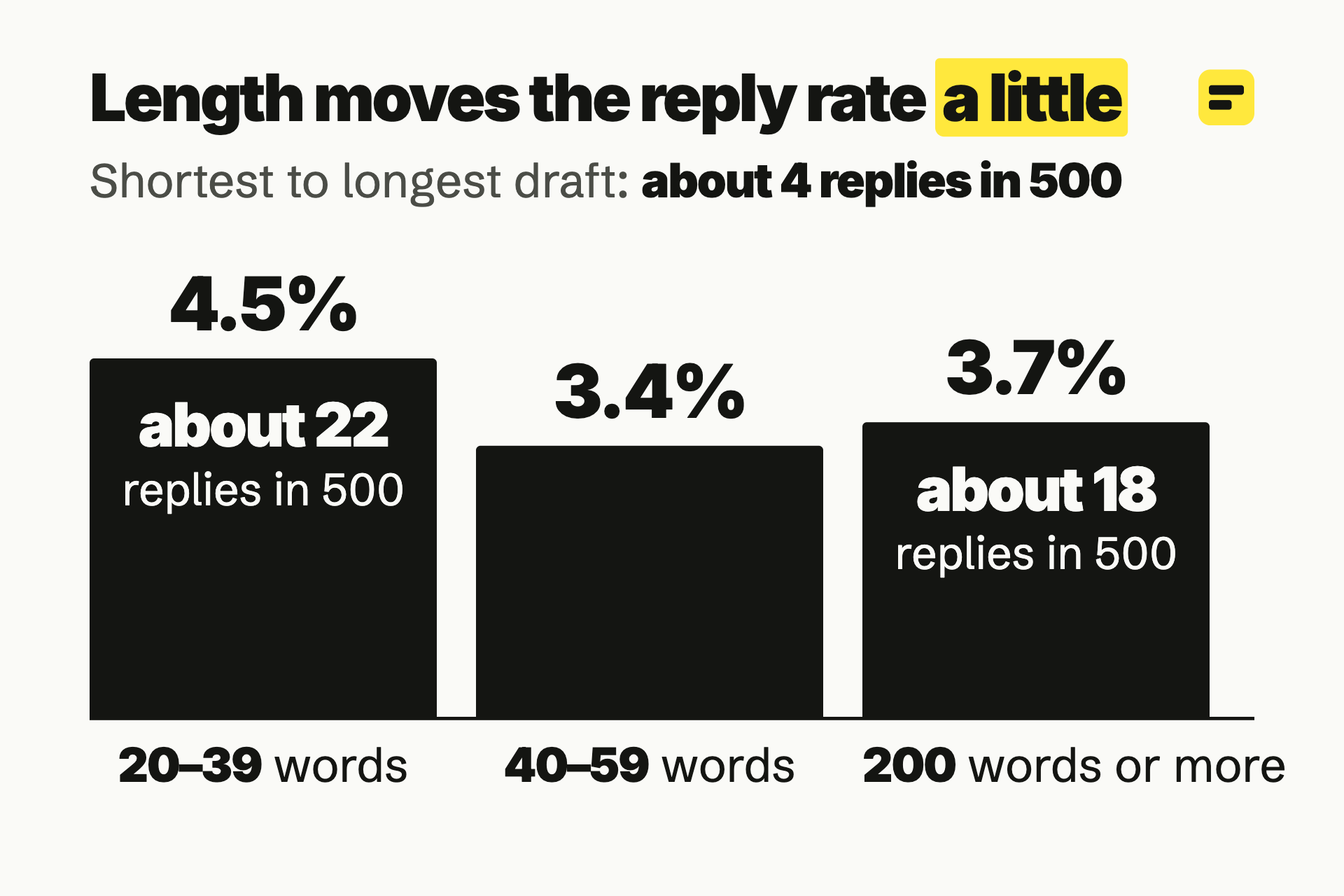
Here is what that means for a real campaign. Take a hypothetical founder of a scheduling tool for dentists who sends 500 first emails. At the best band, 500 × 4.5% = 22.5, so about 22 replies. At 200 words or more, 500 × 3.7% = 18.5, so about 18 replies. The difference between the shortest and the longest drafts is about 4 replies out of 500.
Four replies matter, but compare them with the content effects in the same kind of data. Boomerang found that emails asking one to three questions were 50% more likely to get a response than emails with no question. Gong found that ROI language in cold emails decreases success rates by 15%. Each of those is a bigger swing than the whole range of word counts in Hunter's table.
What to fix before you count words
If length is a small lever, the larger ones are what the email says and who gets it. Check these before you trim a single sentence.
- The person. A short email to someone who does not own the problem gets no reply at any length.
- The reason you write now. One specific line about their company or a thing they said in public.
- One clear question they can answer in a sentence, not a request for a 30-minute call in the first email.
- Plain words. Boomerang found emails written at a third-grade reading level beat college-level emails by 36%.
- No promised results. Claims like double your revenue read as ROI language, which Gong linked to lower success.
The reading level point comes from the same Boomerang study, which measured a 36% lift for emails written at a third-grade reading level over college-level ones. Simple words make an email shorter on their own, without a word target. For the line that shows you know the person, see seven ways to personalize a cold email.
The person matters most, and it is the step founders skip. LitePal finds companies that fit a product, the decision-maker to write to with a checked email, and a drafted first line. The founder then sends from their own account. That way the first line has a real reason behind it, which is worth more than any cut you make to the word count.
A cold email length you can use today
Here is a working rule that fits all three cold email studies at once. Write the first email in 50 to 100 words. Put one line about them, one line about the problem you solve, and one question. If the draft goes above 100 words, cut the description of your product first, because the reader does not need features yet. If it goes below 30 words, check that it still says why you chose this person.
Follow-ups can be shorter, since the context is already in the thread. Keep the subject line short and plain as well; the same principles apply there, and our guide to cold email subject lines has the details. Then measure the result on replies, not opens, and compare it with what a good cold email reply rate looks like before you change the length again.
Test one thing at a time. If you want to know whether length matters for your market, send two versions that differ only in length to two groups of at least a few hundred people each. With Hunter's numbers, a gap of one or two points is all you should expect, so small samples will tell you nothing.
Start with the right person and a real reason to write. Paste your site into LitePal to see companies that fit your product, the person to email at each one, and a first line drafted for you.

