How to run a SaaS demo: 7 questions founders ask
What order to follow, how long to talk and how to end a demo, with numbers from 67,149 recorded sales calls.
November 12, 2026, 7 min read
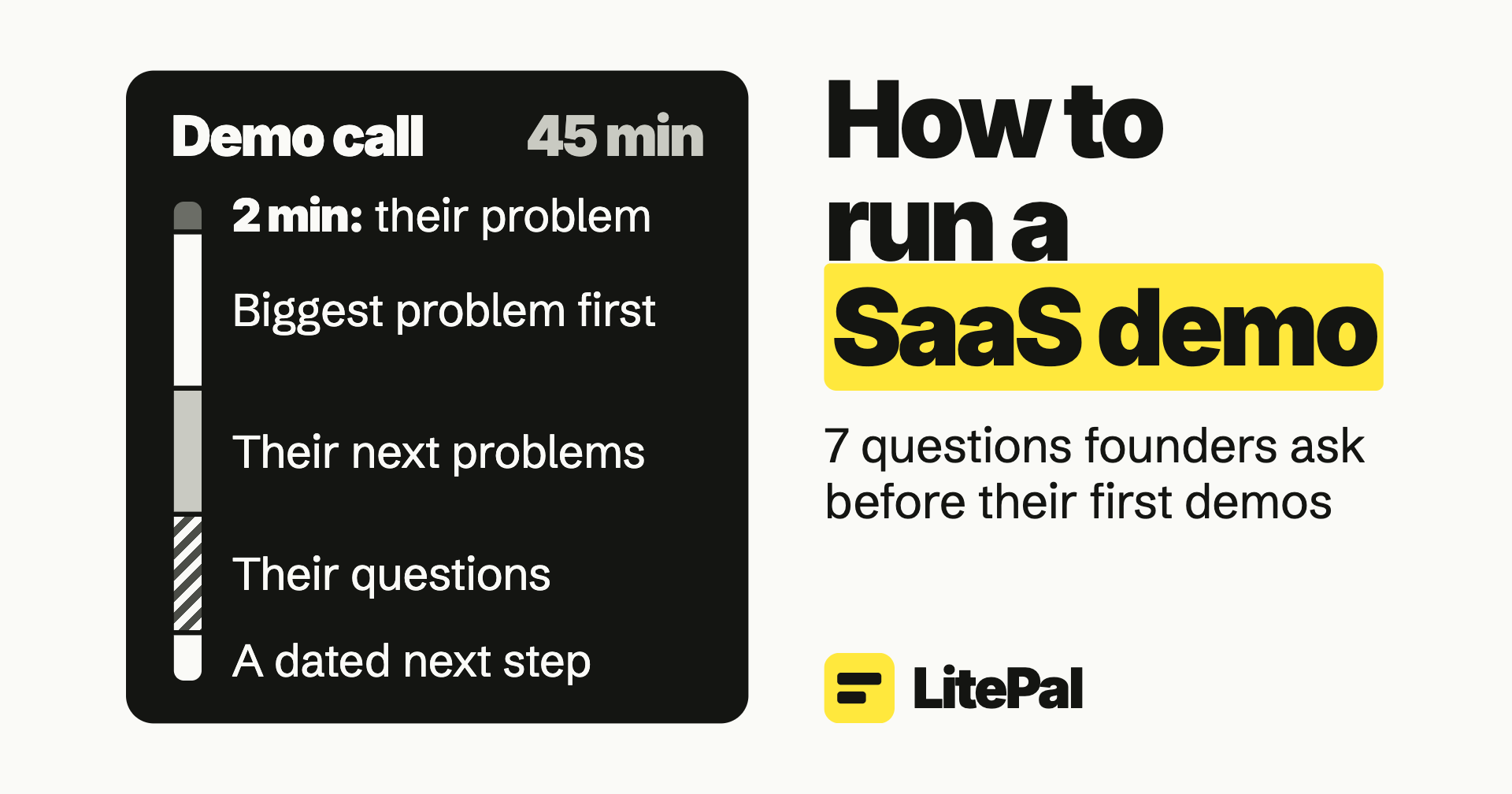
To run a SaaS demo that leads to a sale, start from what the buyer told you in discovery, show the part that solves their biggest problem first, and talk in short bursts so they can interrupt. Keep it under an hour and end with a booked next step. The rest of this post answers the questions founders ask before their first demos.
Most founders run their first demos without a sales team and without a script. That is fine. A demo is a conversation about one buyer's problem with your product on the screen, and you already know the product better than anyone. What follows is how to shape that conversation, with the numbers that exist and the arithmetic for a real call.
Do I need a discovery call before the demo?
Yes, or at least a discovery part at the start of the call. Canny's guide to remote demos says a discovery call should take less than 30 minutes and asks you to learn the buyer's problems and the outcome they want before you show anything. Without that, you show features in the order you built them, and the buyer has to do the work of mapping them to their week.
If you have not run discovery calls before, the questions in our customer discovery interview playbook work here too. Write down the problems the buyer names and how long they talk about each one. You will use that list in the demo.
What order should a SaaS demo follow?
Follow the buyer's priorities, not your feature list. Gong analysed 67,149 recorded sales demos and found that winning demos mirror the topics of the discovery call: the first part of the demo covers the problem the buyer spent the most time on, the second part covers the next one, and so on. Gong calls the common mistake the upside down demo, where the rep saves the best part for last.
The same study describes four phases in demos that closed. They opened with a short context overview of the problem, usually under two minutes, then went straight to the most valuable part. The back and forth grew as the call went on. A simple outline for a founder looks like this:
- Two minutes: the problem in the buyer's own words, read back from your discovery notes.
- The workflow that solves their biggest problem, shown with data that looks like theirs.
- The second and third problems, each tied to a screen, not to a feature name.
- Their questions, as many as they have.
- The next step, agreed and put in a calendar before the call ends.
How long should a SaaS demo be?
Aim for 45 minutes and let the buyer's questions decide the rest. Canny recommends you keep the demo to 45 minutes or less and hold it within five business days of the discovery call. Gong found that successful demos ran 47 minutes against 36 minutes for unsuccessful ones, or 30.5% longer.

Read that second number with care. Gong itself warns that the length is likely a result, not a cause: a targeted demo starts more conversation, and conversation takes time. Padding a demo with extra features will not make it work.
How much should I talk during a demo?
You will talk most of the time, and that is normal. Gong measured a winning talk-to-listen ratio of 65:35 in demos, while unsuccessful demos averaged 66:34, so the total does not separate good demos from bad ones. What separates them is the length of each monologue. Unsuccessful demos had uninterrupted pitches of up to 106 seconds, and Gong did not find a single closed deal in its analysis with a pitch longer than 76 seconds. Successful demos had 21% more speaker switches per minute.
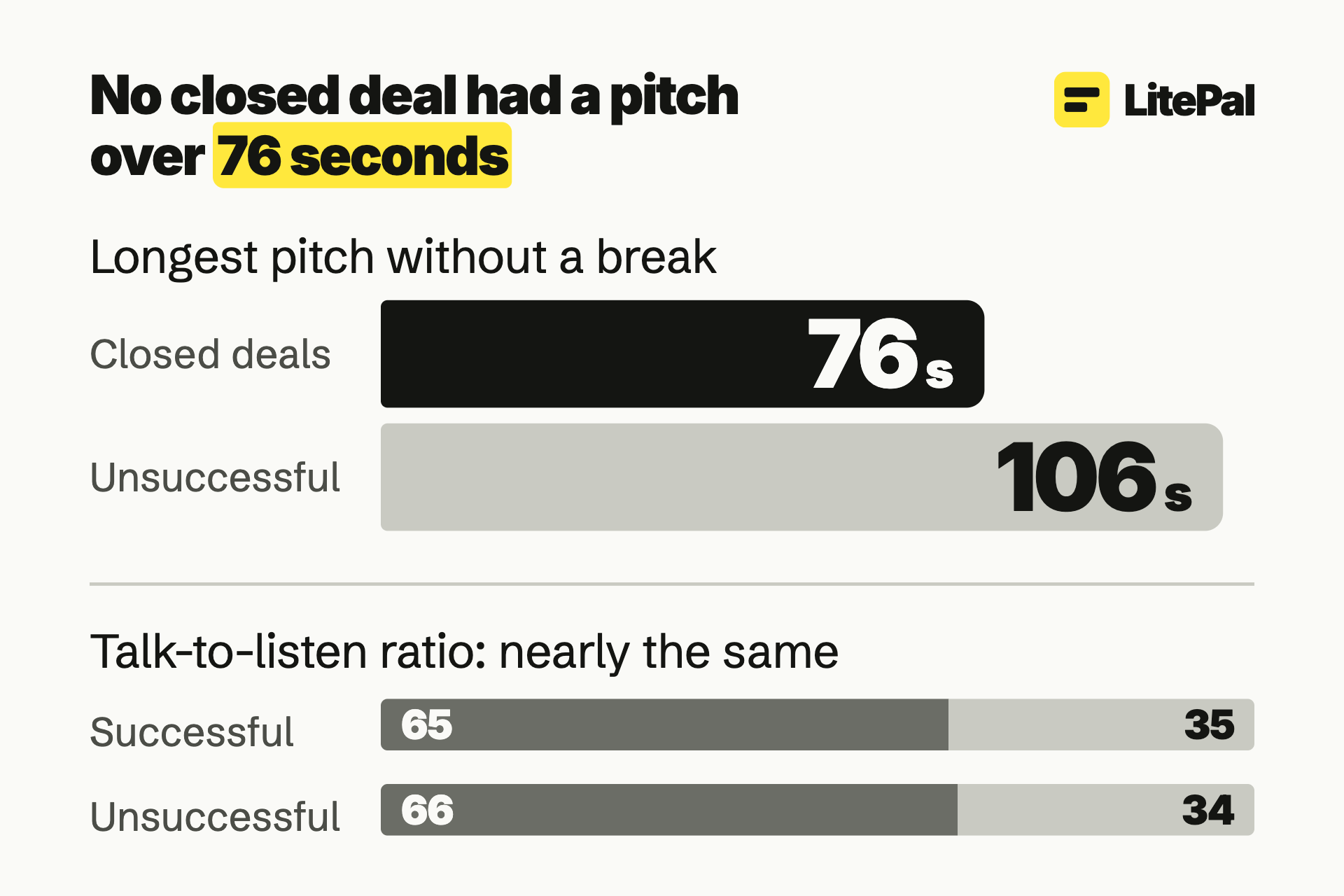
Here is what that means for a 45-minute call. At 65:35 you talk for about 29 minutes (45 x 0.65 = 29.25). That is about 1,755 seconds. If no stretch can be longer than 76 seconds, you need at least 24 breaks where the buyer speaks (1,755 / 76 = 23.1, rounded up). In practice, stop after each screen and ask one question: does this match how your team does it today?
Questions from the buyer are the signal to watch. In a separate Gong analysis, top performers got nearly one-third more questions from buyers during demos than mid-performers, and spent 39% less time on technical topics and features. Show enough to make the buyer curious, then let their questions pick the next screen.
What does the buyer already know when they join?
More than you think. In Wynter's 2024 survey of 100 B2B SaaS marketing executives, 91% said they come to a sales meeting already familiar with the vendor, and 97% check out the vendor website first. The same survey found that 78% of buyers shortlist only 3 vendors to get a demo with, and 83% follow a purchase process through a sales rep.

So skip the company history and the generic tour. The buyer has seen your homepage. Ask what they looked at and what made them book the call, then start from there. If you want to know how buyers build that shortlist, our post on how B2B buyers choose software goes deeper.
What does a good first demo look like for a small product?
Take a hypothetical product: a scheduling tool for dentists. In discovery, the practice manager spent most of the time on no-shows, some time on staff rotas, and a little on reminders by text. The demo opens with two minutes on no-shows in their words, then shows the screen that fills a cancelled slot from the waiting list. Rotas come next. Text reminders come last, because they mattered least to this buyer, even if the founder is proudest of them.
Many first demos come from a conversation, not a form. A founder who answers a public thread where someone asks for a tool like this already has the buyer's problem in writing. LitePal finds those threads on Reddit, Hacker News, X and Threads and drafts a reply for each, and the founder posts it from their own account. When that person books a call, the thread is your first discovery note.
How do I end a demo?
End with a next step that has a date. Canny's guide says never to end a demo call without knowing what both sides will do next, and Gong's list of mistakes includes ending the call without discussing next steps. Before you hang up, agree on one of these:
- A trial with their own data, with a check-in call booked.
- A second call with the person who signs, if they were not on this one.
- A short written summary from you that answers the questions you did not reach.
- A clear no, which is also a result and saves both sides a month of follow-ups.
Then write down what you learned. After ten demos, the questions buyers ask most are the first thing your next demo, and your homepage, should answer. For the wider routine around these calls, see our first-year guide to founder-led sales.
Before your next demo, find the people who already ask for what you built: paste your site into LitePal and get the public threads where they ask, each with a reply drafted for you.

